

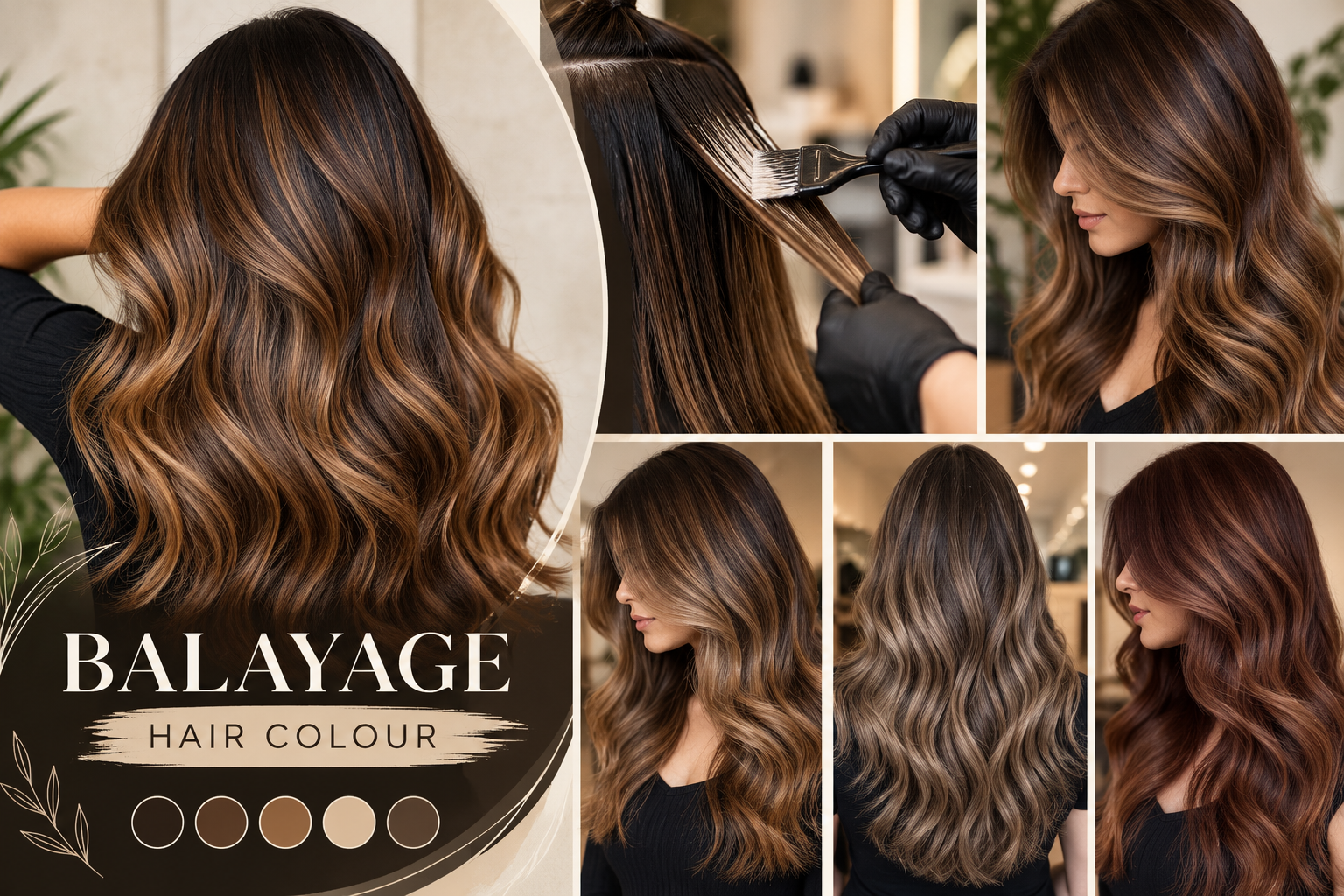
Balayage hair colour is a popular hair colouring technique that creates soft, blended highlights with a natural-looking transition between darker roots and lighter lengths. Unlike traditional highlighting methods that often create more defined sections of colour, balayage uses a freehand application technique to customise where lightness appears throughout the hair.
Whether you want subtle caramel tones, warm honey highlights, a cool blonde finish, or added dimension to dark hair, balayage can be adapted to different hair colours, lengths, and textures.
Understanding how balayage works, which styles are available, and how to care for coloured hair can help you choose a look that suits your preferences and maintenance routine.
Key Takeaways
- Balayage hair colour creates soft, blended highlights for a natural, dimensional look.
- Popular styles include blonde, caramel, honey, chocolate brown, and ash balayage.
- Unlike traditional highlights, balayage often provides a softer transition at the roots and less noticeable regrowth.
- Lightening can cause dryness or breakage, so professional application and proper hair care are important.
- Use colour-safe products, conditioning treatments, and heat protection to maintain your balayage.
- Choosing the right shade depends on your natural hair colour, desired look, hair condition, and maintenance routine.
What Is Balayage Hair Colour?
Balayage is a French hair colouring technique derived from the word balayer, meaning “to sweep”. The name describes how a colourist sweeps or paints lightener onto selected sections of the hair to create a graduated, blended effect.
The colour is generally concentrated through the mid-lengths and ends, with softer transitions near the roots. This creates a multidimensional finish rather than a uniform colour from root to tip.
Balayage is a technique, not a specific hair colour. It can be used to create blonde, caramel, chocolate brown, copper, and other customised colour combinations.
For example, someone with naturally dark brown hair may choose caramel balayage to introduce warmth and dimension without colouring the entire head. Someone with lighter hair may prefer beige or honey-blonde balayage for a brighter finish.
The final result depends on the starting hair colour, hair condition, desired level of lightness, and the colourist’s application technique.
What Are the Benefits of Balayage Hair Colour?
Balayage is popular because it offers a customised colour result and can be adapted to different styles and maintenance preferences.
1. Natural-looking colour transitions
One of the main benefits of balayage is its soft transition between the natural root colour and lighter sections. The freehand application allows the colourist to vary the placement and intensity of the highlights.
This can create a sun-kissed appearance without a strong, uniform line between coloured and uncoloured hair.
2. A personalised finish
Balayage can be customised according to your natural hair colour, skin tone, haircut, and preferred level of contrast.
For a subtle result, a colourist may use shades close to your natural colour. For a more noticeable transformation, lighter tones can be placed through the mid-lengths, ends, and selected face-framing sections.
3. Less noticeable regrowth
Because balayage is often applied away from the roots, new hair growth may blend more naturally with the existing colour than it does with traditional root-to-tip highlights.
This can reduce the need for frequent root touch-ups. However, the maintenance schedule depends on the placement, contrast, chosen tone, and how quickly your hair grows.
4. Added depth and dimension
Balayage highlights can create the appearance of depth by combining lighter and darker sections. This variation can make the colour look more dimensional, particularly when the tones complement the natural base colour.
The effect can be subtle or high contrast, depending on the desired outcome.
5. Flexible styling options
Balayage can be tailored to straight, wavy, and curly hair. Strategic placement can highlight layers, face-framing sections, or the ends of a haircut.
The technique also works across a range of hair lengths, although the available placement and blending options differ depending on the haircut.
What Are the Different Types of Balayage Hair Colour?
The best balayage style depends on the colour you want to achieve, your natural base, and the amount of contrast you prefer.
1. Blonde balayage
Blonde balayage introduces lighter blonde tones into the hair while retaining some of the natural base colour. Depending on the starting shade, the result can range from warm golden blonde to beige or cooler blonde tones.
It is suitable for people who want a brighter appearance without necessarily colouring every strand.
2. Caramel balayage
Caramel balayage combines warm caramel tones with a brown or dark brown base. The result adds warmth and contrast while maintaining a relatively natural-looking finish.
It is a popular option for brunettes who want visible colour variation without moving towards a very light blonde.
3. Chocolate brown balayage
Chocolate brown balayage uses lighter brown shades against a darker brown base. The difference between the shades is generally subtle, creating dimension without an extreme colour change.
This style works well for people who prefer understated colour rather than high-contrast highlights.
4. Honey balayage
Honey balayage incorporates warm golden tones that can brighten the appearance of brown or dark blonde hair.
The colourist can adjust the warmth and brightness to suit the desired result. A consultation is useful if you want to avoid a finish that appears too yellow or too warm.
5. Ash balayage
Ash balayage uses cooler beige, brown, or blonde tones to create a less golden finish.
Achieving these tones may require additional lightening and toning, particularly when starting with darker hair. The condition of the hair should be assessed before attempting a significant colour change.
6. Balayage on dark hair
Balayage on dark hair usually involves lifting selected sections to a lighter shade while keeping the natural base visible.
Caramel, chestnut, mocha, and warm brown tones can provide a softer transition. Lighter blonde results may require multiple sessions, depending on the existing colour and condition of the hair.
7. Face-framing balayage
Face-framing balayage places lighter sections around the front of the hair to draw attention to the face.
It can be combined with highlights throughout the lengths or used as a more subtle colour service. The placement and brightness should be selected to complement the haircut and desired finish.
Balayage vs Highlights: What Is the Difference?
Balayage and traditional highlights both introduce lighter sections into the hair, but they differ in application, appearance, and maintenance.
| Feature | Balayage | Traditional highlights |
|---|---|---|
| Application | Usually painted freehand onto selected sections | Often applied to woven sections using foils |
| Appearance | Soft, blended colour transitions | More defined and evenly distributed highlights |
| Root effect | Often leaves a softer root area | Can begin closer to the roots |
| Regrowth | Usually less noticeable | May become more visible as roots grow |
| Maintenance | Often requires fewer touch-ups | Frequently needs more regular root maintenance |
| Best suited for | Natural-looking dimension and blended colour | More uniform brightness and defined lightness |
Neither technique is automatically better. The right choice depends on your preferred result, natural hair colour, existing colour history, and maintenance routine.
Balayage may be preferable if you want blended colour and softer regrowth. Traditional highlights may be more suitable if you want greater overall brightness or a more consistent distribution of lighter sections.
A professional colourist can also combine the two techniques to achieve a customised finish.
Does Balayage Damage Hair?
Yes, balayage can damage hair, particularly when the process involves lightening the hair with bleach or another lightening product. However, the amount of damage varies according to the hair’s starting condition, the degree of lightening required, processing time, product selection, and previous chemical treatments.
Balayage should not automatically be considered damage-free simply because it is applied freehand or does not always begin at the roots.
Factors that influence hair damage
The amount of lightening required: Moving from dark brown to a very light blonde generally requires more lightening than adding a few caramel tones.
Previous colour treatments: Hair that has already been bleached, coloured repeatedly, or chemically treated may be more vulnerable to damage.
Overlapping lightener: Reapplying lightener to previously lightened sections can increase the risk of dryness and breakage.
Hair condition: Hair that is already fragile, excessively dry, or breaking may need restorative care or a more conservative colour plan before further lightening.
How to reduce the risk of damage
Have your hair assessed by an experienced colourist before the service.
Discuss your previous colour history, including at-home dyes and chemical treatments.
Choose a realistic target shade instead of trying to achieve a dramatic transformation in one session.
Follow professional processing and aftercare recommendations.
Use a colour-safe shampoo, conditioner, and a suitable conditioning treatment.
Apply heat protection before using hot styling tools.
Avoid unnecessary overlapping of lightener during future appointments.
A strand test may be recommended when the colour history is complicated or the hair’s condition is uncertain.
If your hair is already severely damaged or breaking, discuss whether lightening should be postponed.
How long does balayage last, and how do you maintain it?
Balayage grows out softly, so it can look good for months. Fading and tone matter more than regrowth.
| Care step | Suggested timing | Why it matters |
|---|---|---|
| Tone or gloss refresh | Every 8 to 12 weeks | Corrects brassiness and restores shine |
| Fuller balayage refresh | About every 3 to 4 months | Re-brightens lengths and blends new growth |
| Hydrating mask | Weekly | Replaces moisture lost during lightening |
| Trim | As advised by your stylist | Removes dry or split ends |
Daily care tips
- Use a colour-safe, sulphate-free shampoo. Gentle cleansers help colour last longer.
- Wash less often if you can. Frequent washing fades colour faster.
- Rinse with cooler water. Hot water can dull colour and dry hair.
- Use a heat protectant before styling, and keep heat tools on a lower setting.
- Use a toning or purple shampoo only if your colourist recommends it. It helps cool down yellow tones on light shades but can be overused.
- Protect from sun, chlorine and hard water. All three can dull and dry coloured hair.
What to expect at your balayage appointment
- Consultation. Your colourist reviews your hair type, colour history and the look you want.
- Sectioning and painting. Colour is brushed on by hand where it will add the most dimension.
- Processing. The colour develops until the target lightness is reached. Time varies with hair length, thickness, condition and starting colour.
- Toning. A toner or gloss sets the final shade and adds shine.
- Treatment and styling. A conditioning treatment and blow dry finish the service.
- Aftercare plan. You receive product advice and a timeline for your next visit.
At Manisa Salon Spa & Aesthetics in Sarabha Nagar, Ludhiana, a personalised consultation before colour helps match the technique, shade and aftercare to your hair.
Frequently Asked Questions
It is a freehand colouring technique where colour is painted on by hand, mainly on the mid-lengths and ends, for a soft, natural look and gentle regrowth.
Highlights use foils and place colour closer to the roots in a defined pattern. Balayage is painted freehand, blends into the natural colour and grows out more softly.
It can, because lightener changes the hair structure. Damage depends on how many shades are lifted, your hair's starting condition and your aftercare. A consultation, staged lightening and conditioning treatments reduce the risk.
The look usually stays presentable for around 3 to 4 months. A tone or gloss refresh every 8 to 12 weeks keeps the shade fresh.
It blends grey hair well but does not fully cover it. For full coverage, choose a global colour.